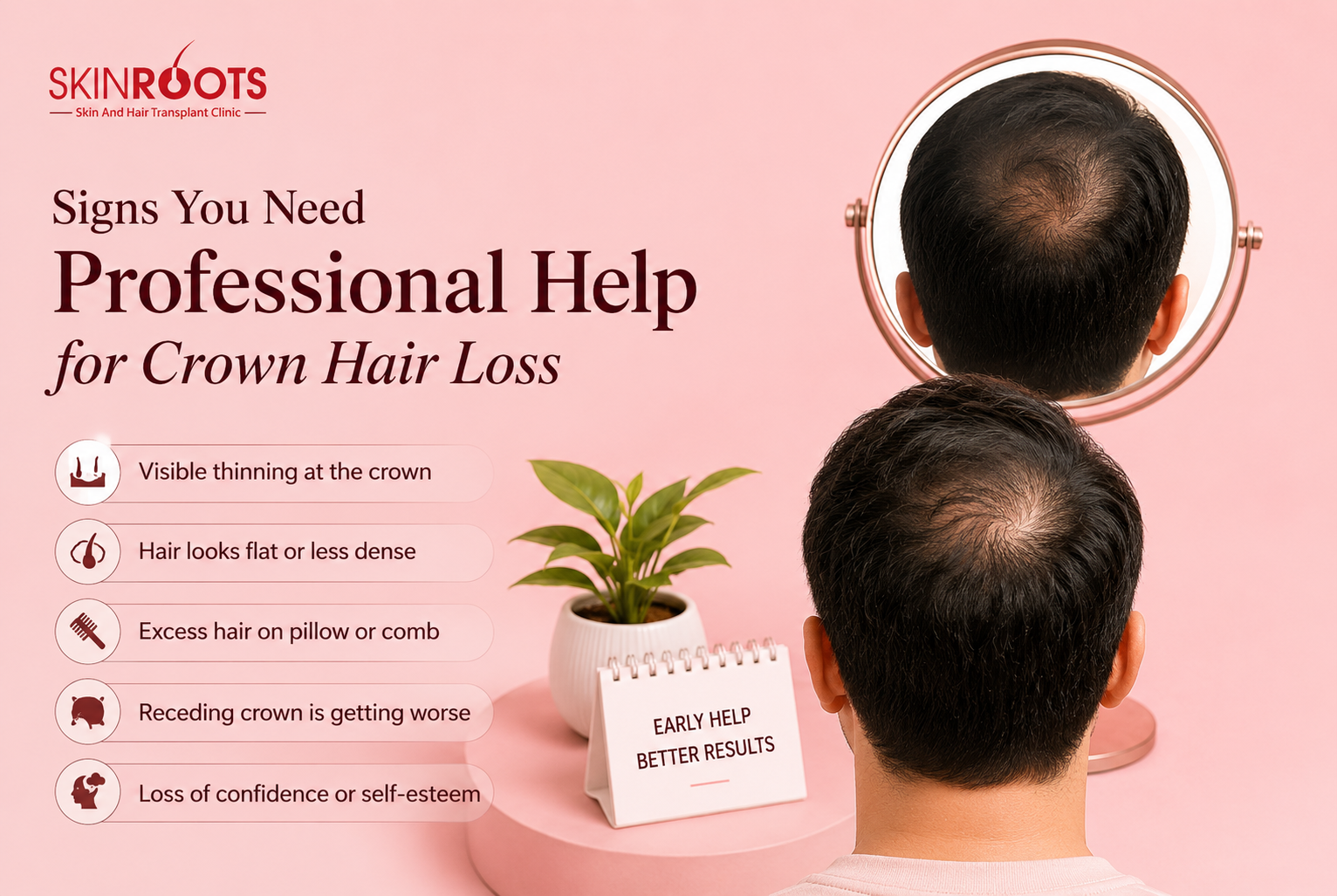
Signs You Need Professional Help for Crown Hair Loss
Hair loss doesn’t begin abruptly. It starts quietly, particularly at the crown. Sometimes, you might not even realise until somebody points it out, or you catch a glimpse in the mirror from an uncomfortable position. But all that starts with a slight hair thinning at crown gradually turns into visible patches, and in that, not only does your look suffer, but your confidence too.
Crown hair loss is among the most rampant but least noticed types of hair fall. Early signs are often ignored by people, who assume it’s temporary or an effect of stress. But postponing action makes things even worse.
Thus, in this blog, we will guide you about the signs and causes of crown thinning, along with helping you understand when it’s the right time to seek professional care.
Understanding Crown Hair Loss
The crown region (top-back part of your scalp) is particularly susceptible to hormonal and genetic factors. This is why crown thinning and balding crown are common early warning signs of underlying hair loss disorders.
This kind of hair loss in many cases is due to Male Pattern Baldness Crown, an effect of genetics and hormones. However, it’s not confined to men; women can also suffer hair loss on the crown, particularly from stress, hormonal imbalances or poor nutrition.
Early Signs You Shouldn’t Ignore
1. Gradual Hair Thinning at the Crown
One of the earliest warning signs is subtle hair thinning at crown. You might notice:
- Your scalp will become more visible under bright light.
- Hair seems flat or less dense.
- It is difficult to set your hair to cover the crown.
This state is commonly reversible, but it needs to be examined early.
2. A Visible Bald Spot on the Crown
If the thinning continues to progress, you can see a bald spot on crown. At this point:
- Hair follicles may be shrinking.
- The hair growth cycle is interrupted.
- Regrowth becomes slower.
Skipping this step can cause permanent crown baldness, which makes treatment more difficult.
3. Increased Hair Shedding
Finding more hair on your pillow, comb, or shower drain? That’s another sign. When excessive shedding is intensified on the crown, it is a sign of worsening crown hair loss.
This isn’t just a seasonal hair fall; it’s your scalp suggesting signs of deeper issues.
4. Hair Becoming Finer and Weaker
Hair becomes thinner before falling out entirely. This process is referred to as miniaturisation, which is common in male pattern baldness crown cases. You may notice:
- Softer, weaker strands.
- Reduced volume.
- Hair that breaks easily.
This is a critical stage as follicles are still alive at the time and can respond to Crown Hair Loss Treatment well.
5. Difficulty Covering the Crown Area
When you’re constantly changing your hairstyle to conceal a balding crown, it’s time to undergo the treatment. Using styling hacks is only temporary.
A professional examination can ascertain whether the baldness is reversible or necessitates advanced crown balding treatment.
6. Family History of Hair Loss
Genetics play a major role. Your chances of developing crown baldness or male pattern baldness crown are heightened even more if some of your parents or family is experiencing it.
In these conditions, early preventive care is even more crucial.
When Should You See a Specialist?
Most people sit at home and hope the situation will be fixed by itself or by following some home remedies. But the fact is, hair loss in its normal course tends not to easily reverse itself once it’s done with.
It is always advisable to visit the Best Hair Transplant Surgeon in Delhi if:
- You experience consistent hair thinning at crown for the consecutively 2 months to 3 months.
- A bald spot on crown appears easily.
- Hair density is falling fast.
- There’s no usage of over-the-counter products.
- You have a family history of crown hair loss.
At Skinroots Clinic, early diagnosis is crucial in helping doctors develop a tailored crown hair loss treatment plan that works for your scalp condition.
What Causes Crown Hair Loss?
Knowing the cause of the crown hair loss helps in selecting the appropriate treatment.
1. Genetics
Heredity is the leading cause of male pattern baldness crown.
2. Hormonal Imbalance
DHT (Dihydrotestosterone) is a type of hormone that acts on hair follicles and causes crown thinning.
3. Stress
Chronic stress interrupts the hair growth cycle, which leads to increasing hair loss at the crown.
4. Nutritional Deficiencies
Lack of iron, protein, or vitamins can weaken hair, which speeds up crown hair loss.
5. Poor Scalp Health
Dandruff, infections, or excessive oil can harm follicles and cause a bald crown.
Why Professional Treatment Matters?
A lot of people use home remedies or generic products, but usually, those do not work because they are not focused on fixing the root cause.
And that’s where the role of professional crown balding treatment comes in, which offers:
- Accurate diagnosis.
- Customised solutions.
- Advanced technologies.
- Long-term results.
At Skinroots Clinic, treatments are tailored to your hair type, scalp condition, and the stage of crown baldness you have.
Treatment Options for Crown Hair Loss
At Skinroots clinic, we offer the following advanced treatment that works effectively to bring back the crown hair and its density:
1. PRP Therapy
Platelet–rich plasma stimulates hair follicles and increases density in places with crown thinning.
2. Medications
Clinically approved treatments can slow the progression of male pattern baldness crown at its onset.
3. Mesotherapy
Injections containing nutrients help hair roots become stronger and reduce hair loss at the crown.
4. Hair Transplant
There are transplant procedures that restore natural hair growth in advanced crown baldness.
5. Laser Therapy
Low-level laser therapy can enhance blood circulation and facilitate Crown Hair Loss Treatment.
Can Crown Hair Loss Be Reversed?
The answer depends on timing.
- Early-stage hair thinning at crown → Highly reversible.
- Moderate balding crown → Manageable with treatment.
- Advanced crown baldness → Requires restoration methods.
This is why early intervention is critical.
How SkinRoots Clinic Helps?
At Skinroots Clinic, the methodology isn’t only about treating symptoms; it’s about knowing your whole hair’s story.
What makes the difference:
- Individual treatment plans.
- Ethical and transparent approach.
- Long-term scalp health focus.
- Advanced dermatologic solutions.
Whether it’s early crown thinning or bald spots on crown that have progressed toward a more complex stage, the goal is to restore hair, as well as confidence.
Final Thoughts
Ignoring crown hair loss is easy until it becomes visible. But by the time you realize, treatment becomes time-consuming and more complicated.
If you see earlier signs, such as hair thinning at crown, don’t wait. Receiving timely, professional attention can save you from the condition progressing to serious crown baldness.
Your hair deserves your attention before it’s too late.
FAQ's
1. What is Crown Hair Loss?
Crown hair loss refers to hair thinning or baldness at the top-back area of the scalp. It often starts subtly and progresses over time.
2. Is Crown Hair Loss Permanent?
Not always. Early-stage crown thinning can be reversed with the right crown hair loss treatment, but advanced cases may require procedures like transplants.
3. How Do I Know if I Have a Balding Crown?
Signs of a balding crown include visible scalp, reduced hair density, and difficulty covering the crown area.
4. What Causes Hair Thinning at the Crown?
Common causes include genetics, hormonal imbalance, stress, and nutritional deficiencies, leading to hair thinning at crown.
5. Can Women Experience Crown Hair Loss?
Yes, women can also face hair loss at the crown, especially due to hormonal changes or stress.
6. What is the Best Treatment for Crown Baldness?
The best crown balding treatment depends on the stage; options include PRP, medications, and hair transplants.
7. How Early Should I Start Treatment?
As soon as you notice crown thinning or increased hair fall, early treatment gives the best results.
Have a skin or hair concern?
Reading about a concern is a useful first step. Speak with the Skinroots team to discuss your concern and available treatment options.
Book a ConsultationRelated articles